September 15, 2026
Ransomware-Ready Disaster Recovery: What Your Plan Must Include to Restore Operations Fast

Too many businesses think backups are the end of the road. When ransomware strikes, they realize backup copies alone don’t restore systems, people, or revenue. A true disaster recovery plan maps out the exact order to bring operations back online, defines key dependencies, and assigns decision-makers to avoid costly delays.
In this post, you’ll learn what a ransomware-ready disaster recovery plan must include to restore your business fast and with confidence. For more on crafting an effective disaster recovery strategy, visit Creating Disaster Recovery and Incident Response Plans.
Building a Ransomware-Ready Recovery Plan
A solid disaster recovery plan is more than just having a backup. It’s about ensuring your business can bounce back quickly.
Beyond Backup: The Full Spectrum
Many believe having a backup equals safety. But a backup is just a piece. Recovery involves bringing systems back online seamlessly. Think about the entire process: from the moment an attack happens to the point where everything runs smoothly again. That’s where you need a well-rounded plan.
Restore Sequence and Role Clarity
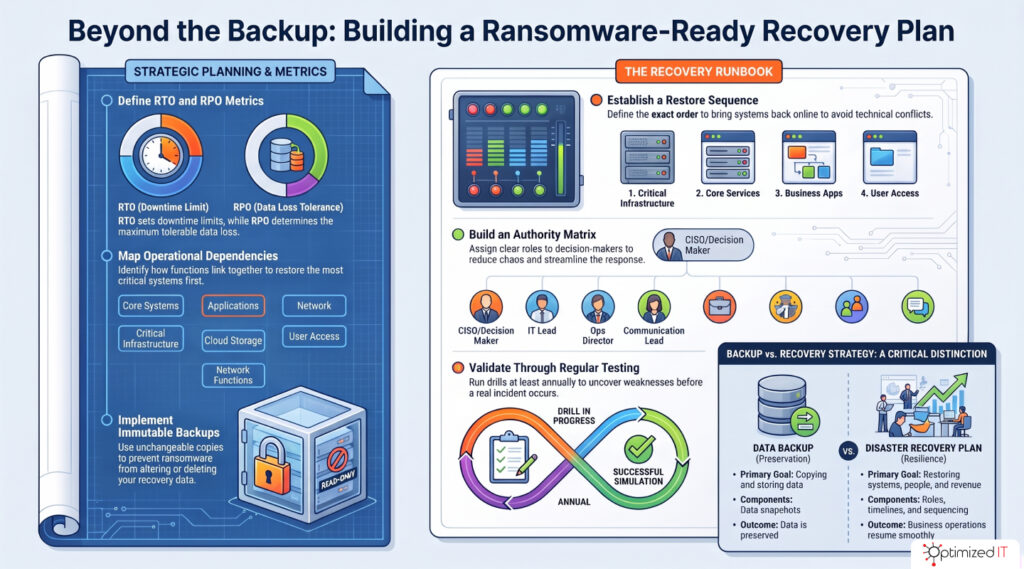
Imagine a puzzle with missing pieces. Without knowing which piece goes where, you can’t complete it. Similarly, in recovery, it’s vital to know which system to restore first. Assign clear roles: who decides, who acts, and in what order. This clarity avoids confusion and speeds up recovery.
Identifying Operational Dependencies
Think of your business as a chain. Every function is linked. If one breaks, others might too. Identify these links ahead of time. Know what depends on what. This way, during a crisis, you can restore the most critical functions first, ensuring a smoother recovery.
Essential Components of a Recovery Runbook
Creating a recovery plan isn’t just about listing steps. It’s about having the right elements in place.
Incident Response and Authority Matrix
Who takes the lead when things go wrong? An authority matrix defines roles and responsibilities. It ensures everyone knows their part. Quick action can prevent further damage. Clearly outlining roles reduces chaos and streamlines decision-making.
RTO and RPO: Key Metrics
RTO (Recovery Time Objective) and RPO (Recovery Point Objective) are crucial. RTO is how long you can afford systems to be down. RPO is the data loss you can tolerate. Together, these metrics guide the recovery process, ensuring minimal disruption to your business.
Disaster Recovery Testing and Validation
Testing is the key. A plan on paper is just a plan. Run drills. Test your systems. Validate that the plan works. This ensures everyone knows what to do when a real incident occurs. Regular testing uncovers weaknesses, allowing you to strengthen your defenses.

Bridging the Gap Between Backup and Recovery
Having a backup is just part of the story. A real recovery plan connects the dots.
Immutable Backups and Failover Testing
Immutable backups are unchangeable. They protect data from being altered or deleted by ransomware. Combine this with regular failover testing to ensure systems switch seamlessly during an outage. This keeps your data and operations secure.
Recovery Orchestration and Business Continuity
Orchestration is about coordinating recovery efforts. It ensures all parts of your plan work together. When done right, it ensures continuous business operations even during disruptions. It’s like having a symphony where every musician knows their part.
The Role of OptimizedIT Managed Services
OptimizedIT can be your partner in managing this complex process. They offer expertise and tools to ensure your disaster recovery strategy is comprehensive and effective. With their support, you can focus on your business, knowing your recovery plan is in expert hands.
Frequently Asked Questions
What is a disaster recovery plan?
A disaster recovery plan outlines steps to restore systems and operations after a disruption. It includes details like roles, responsibilities, and timelines to ensure a quick recovery.
How often should we test our recovery plan?
Testing should be done regularly, at least annually. This ensures the plan is effective and everyone knows their role during an incident.
What’s the difference between a backup and a disaster recovery plan?
A backup is a copy of your data. A disaster recovery plan is a comprehensive strategy that ensures your business can restart smoothly after a disruption.
Why are RTO and RPO important?
RTO and RPO determine how long your business can afford to be down and how much data loss is acceptable. They guide the recovery process, minimizing impact on operations.
What role does OptimizedIT play in disaster recovery?
OptimizedIT provides expertise and tools to manage and execute your disaster recovery plan, ensuring your business can recover quickly and effectively.